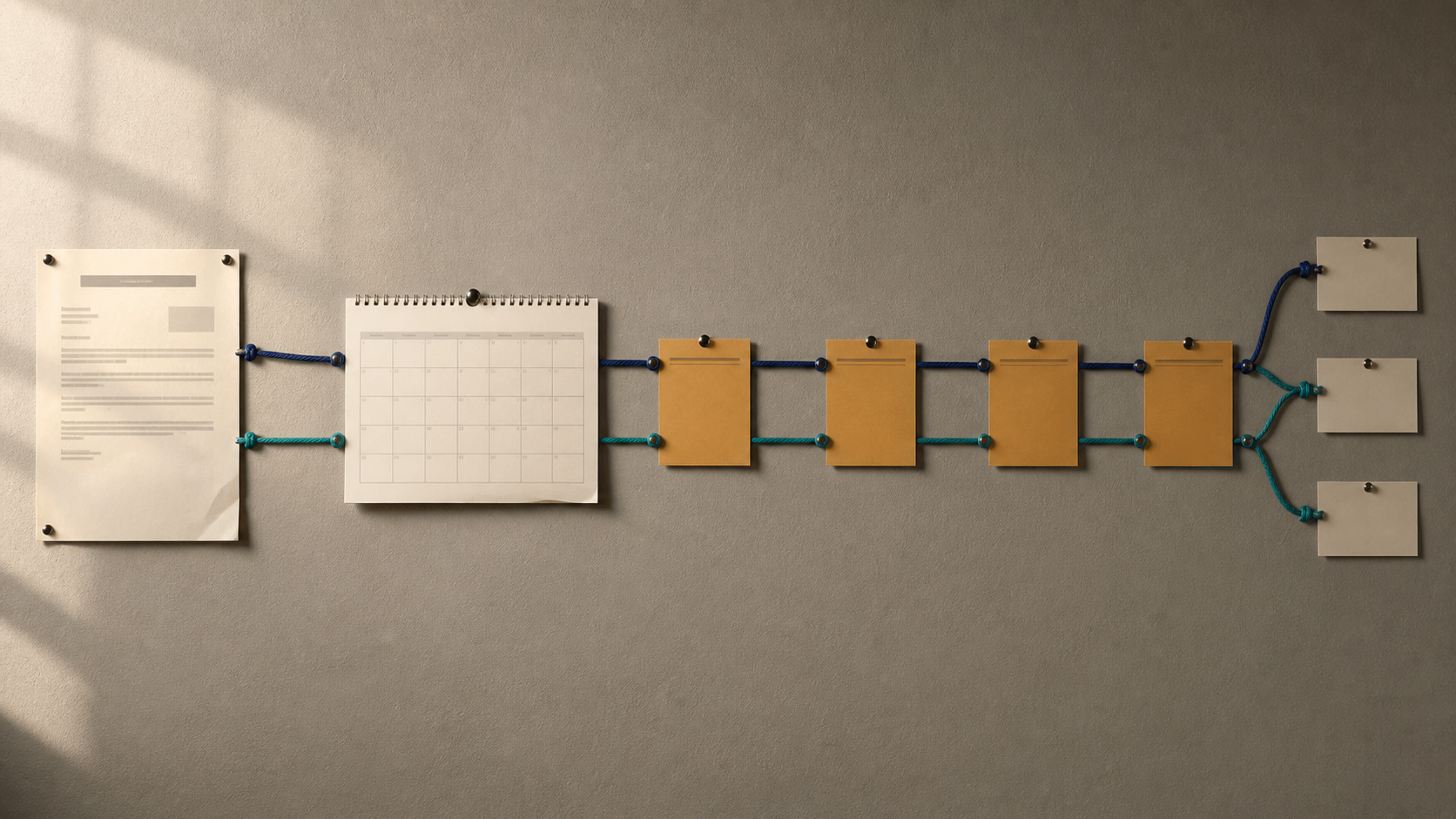
The Notice to Schedule has arrived. One applicant immediately looks for the first open appointment; another begins reviewing material for a trade classification that was not assigned. A sound CSLB exam planning route starts one step earlier: read the accepted application path, confirm the examinations the board has referred, and only then build the study and scheduling calendar.
For most qualifying individuals, that calendar has two parallel tracks: Law and Business, plus the applicable trade examination. Each track starts from a different official guide and measures readiness against a different scope. They meet at practical milestones—appointment selection, final logistics and results—but they should not be blended into one generic study list.
This guide is the route map. It shows where to branch, where to merge and what decision comes next. Detailed Law and Business work, classification-specific trade study and live scheduling instructions remain in their dedicated guides, so the plan stays useful without becoming a duplicate curriculum or a stale test-center checklist.
Read the referral before building the timeline
The Notice to Schedule is the operational trigger. The licensing board first accepts and refers the application for testing; the applicant then uses the notice to schedule and pay for each assigned examination through PSI. Before choosing a date, compare the notice, the application classification and the current official study-guide directory.
From examination referral to scheduling readiness
Confirm assigned examinations
Compare the accepted application path and Notice to Schedule before choosing study materials or dates.
Open the current official guides
Use the current official Law and Business guide alongside the guide for the exact assigned classification; verify whether a trade exam is included.
Move to scheduling readiness
Reconnect the two study tracks, then follow the current notice and PSI instructions for appointments and test day.
The first step is an assignment check, not a study-material purchase. Write down the examination names shown for the application. The normal qualifying route includes Law and Business and an applicable trade examination, but the accepted application controls the actual path. For example, the current official guide directory identifies C-61 Limited Specialty as having no trade examination. Other possible exceptions or waivers depend on the board's review; a reader should not self-approve one from a summary.
Next, match each assigned examination to its current official guide. Record the guide title or classification, the date or version language that matters for the scheduled exam, and the topics that need a first review. This prevents a familiar trade name, an old PDF or a neighboring classification from quietly becoming the study scope.
Only after those two checks should appointment timing enter the calendar. The notice and current PSI instructions govern the live workflow, so the plan should reserve a verification point before scheduling and another shortly before test day. Appointment availability, locations and change procedures can move; a copied checklist is weaker than a dated check against the instructions attached to the application.
Think of the referral as the left edge of a wall timeline. The guide selections sit next, the two preparation tracks occupy the middle, and the appointments and results sit on the right. If an item cannot be placed on that line, it probably belongs to an application, classification or licensing task outside this exam plan.
Split the plan into two examination tracks
Law and Business and the applicable trade examination are parallel planning tracks because they test different bodies of knowledge. The Law and Business guide organizes licensing and business responsibilities; a trade guide is tied to the exact classification and its technical scope. Both can use review, retrieval and practice, but the source outline for one should never fill gaps in the other.
The tracks also share a few controls. Each begins with the current official guide, each needs a realistic readiness checkpoint, and each eventually reaches the current scheduling workflow. Keep those shared controls in the main timeline while storing the subject-level work inside the appropriate branch.
Swipe horizontally to view all columns.
| Exam track | Official starting input | Scope anchor | First planning action | Merge milestone |
|---|---|---|---|---|
| Law and Business | Current official Law and Business study guide | Business, licensing and legal responsibility domains | Map every domain, run an initial retrieval check and record recurring errors | Guide version and next review checkpoint are clear |
| Applicable trade examination | Current official guide for the exact classification | Classification-specific technical outline and referenced resources | Convert guide topics into source review, calculation, procedure and scenario tasks | Classification match and next review checkpoint are clear |
Use the table as a routing device, not as a prediction. It deliberately leaves out passing percentages, stable question counts, prep-company rankings and guaranteed study-hour targets because the approved official sources do not support those shortcuts. Readiness is better expressed as completed source review, explainable errors and rehearsal under the stated exam conditions.
A simple calendar can show both branches without forcing them to move at the same speed. Give each track its own review milestones, then mark the points at which an appointment decision needs information from both. If one branch is still using the wrong guide or producing the same errors, the shared milestone is not ready merely because the other branch is progressing.
The split also creates clean boundaries for help. Questions about the seven Law and Business domains go to its dedicated exam guide. Questions about the technical outline go to the exact trade guide. Questions about the notice, PSI appointment or test-day rules go to the scheduling guide. The hub remains the map connecting those tasks.
Build the Law and Business branch from its current guide
Start the Law and Business branch with the guide currently linked by CSLB. It supplies the content outline, approximate domain weights, sample questions, reference resources and test strategy. Because the examination is closed book, the branch needs to move beyond recognizing a rule on a page toward recalling and applying it without the source open.
Keep the first pass broad enough to expose weak areas. Scan every official domain, note unfamiliar responsibilities or sequences, and try a small set of retrieval questions. The approximate outline percentages can help organize the workload, but they do not predict an individual exam form and should not become a promise that a particular allocation will produce a pass.
Then convert misses into the next review decision. A useful error note says what choice was made, why it was tempting, what rule or distinction resolves it, and when it will be tested again. That creates a loop: source review, closed-book recall, mixed rehearsal, then a return to the errors that repeat. Simply rereading the strongest domain does not advance the timeline.
Set a branch milestone that can be observed. Examples include explaining a licensing responsibility without notes, separating two contract scenarios that were previously confused, or completing a mixed set while recording the reasoning behind every changed answer. These are planning signals, not official scoring rules, and they make the calendar responsive to evidence rather than confidence alone.
For a domain-level workload map and a fuller study loop, use the detailed Law and Business exam plan. Return to this hub when that branch has a defensible next review date and needs to reconnect with the trade track and the appointment plan.
Build the trade branch around the exact classification
The trade branch begins with the classification assigned to the application, not with a broad idea of the applicant's occupation. Open the current guide for that exact classification, confirm that it matches the notice, and use its topic outline and referenced resources as the boundary. Adjacent classifications can share vocabulary while assigning different scope, so mixing guides can create confident study in the wrong lane.
Before building review cycles, confirm that the accepted path actually includes a trade examination. The normal route includes the applicable trade exam, while the official directory identifies C-61 Limited Specialty as an exception with no trade examination. Waiver or reciprocity questions also require the current board determination; they should not be converted into a self-declared exemption on a calendar.
For an assigned trade exam, turn the guide into a source pack. List the technical topics, references or calculations that need review, then connect each one to a task: explain a procedure, set up a calculation, diagnose a field scenario or retrieve a safety responsibility. The aim is not to reproduce the agency outline. It is to make every guide item point to an action and a later check.
Give this branch its own error categories. A missed unit conversion needs a different repair from a confused sequence, a scope boundary or a safety decision. Grouping misses by cause reveals whether the next session should revisit the source, rehearse a procedure or mix scenarios. That distinction keeps the trade plan grounded in the work while still preparing for closed-book, multiple-choice testing.
The classification-specific trade exam study plan develops that source-pack method without creating thin pages for every classification. After both examination tracks are mapped, readers who want an independent option can also review exam-preparation resources from Test2Pro. It is a third-party resource, not an official agency site or endorsement, and it does not replace the current official guide.
Finish the branch with a clear handoff: the correct classification guide is confirmed, initial review tasks exist, recurring errors have a return date, and the branch has a checkpoint for deciding whether an appointment is realistic. Only then should it merge with the common scheduling line.
Merge study, scheduling, and test-day checkpoints
Merge the two tracks when their assigned examinations and guide versions are clear—not when every subject feels complete. At that point, the calendar can connect study evidence to the Notice to Schedule, current appointment options and the practical time needed for final review. A date should serve the plan; it should not become an arbitrary deadline that hides an unfinished branch.
The current qualifying examinations are taken in person on a computer, use multiple-choice questions and allow 3.5 hours for each examination. Those conditions suggest a useful common rehearsal point: both branches should include closed-book work, sustained attention and decisions about how to handle uncertain questions. That does not make their subject matter interchangeable. It gives them a shared test-condition checkpoint.
Build the merge around three moments. Before scheduling, verify the notice, assigned exams, guide versions and the amount of branch work still open. After scheduling, preserve the confirmation and recheck the current instructions for the location, identification, permitted items and appointment changes. Before test day, use the live instructions again rather than relying on a saved summary or an earlier applicant's routine.
Do not hard-code appointment availability or assume that Law and Business and trade exams have identical location options. Live operations can change, and the applicant's notice is closer to the actual case than a general article. If the plan needs a cancellation or rescheduling decision, stop and check the accepted PSI channel and the current deadline before acting.
The application timeline puts a firm boundary around the exam route. Applicants have 18 months from application acceptance to pass the required examinations. That window is not a recommended study duration, and it is not an appointment guarantee. Record the application void date as a control point, then leave enough space for the remaining exam, a possible retake and any instructions that follow the results.
For the operational sequence from notice through appointment and test day, follow the current contractor-exam scheduling and test-day steps. Keep the official source links on this page as the final live check; they are separated below so changing agency URLs do not get repeated throughout the article.
Choose the next milestone from the current result state
The result changes the route, but it does not erase the timeline. The board provides results at the end of the examination. From there, identify the state that applies: another assigned examination remains, a retake is needed, or all required examinations have been passed and the application moves toward the remaining licensing requirements.
If another assigned exam remains, move the open branch to the front. Preserve what worked in the completed branch, but do not spend the next review cycle repeating it by habit. Recheck the remaining guide, error categories and appointment instructions, then set the next observable milestone.
If a retake is needed, use the section breakdown on the failing report to choose the next repair. The current rule requires a 21-calendar-day wait before retesting, and a new PSI fee applies. The 18-month application window and void date still control, so the plan must account for both the waiting interval and the remaining room for another attempt. The interval is a boundary, not proof that the same study routine will improve the result.
If all assigned exams are passed, follow the next instructions tied to the application. Passing an examination does not itself constitute licensure; other issuance requirements can remain. Keep the result with the application records and treat the next licensing-board milestone—not the score report alone—as the end of this exam-planning route.
A fourth state deserves attention: the void date is approaching while an examination remains open. Do not invent an extension or rely on an old anecdote. Compare the date, the required examination, the retake boundary if relevant and the current application instructions, then contact the official route when the remaining time is unclear.
The plan is complete when the next milestone is specific to the reader's current state: deepen one study branch, complete the scheduling workflow, prepare a retake or continue the licensing process. That decision is more useful than a generic conclusion because it keeps the accepted application—not a stock study calendar—in control.