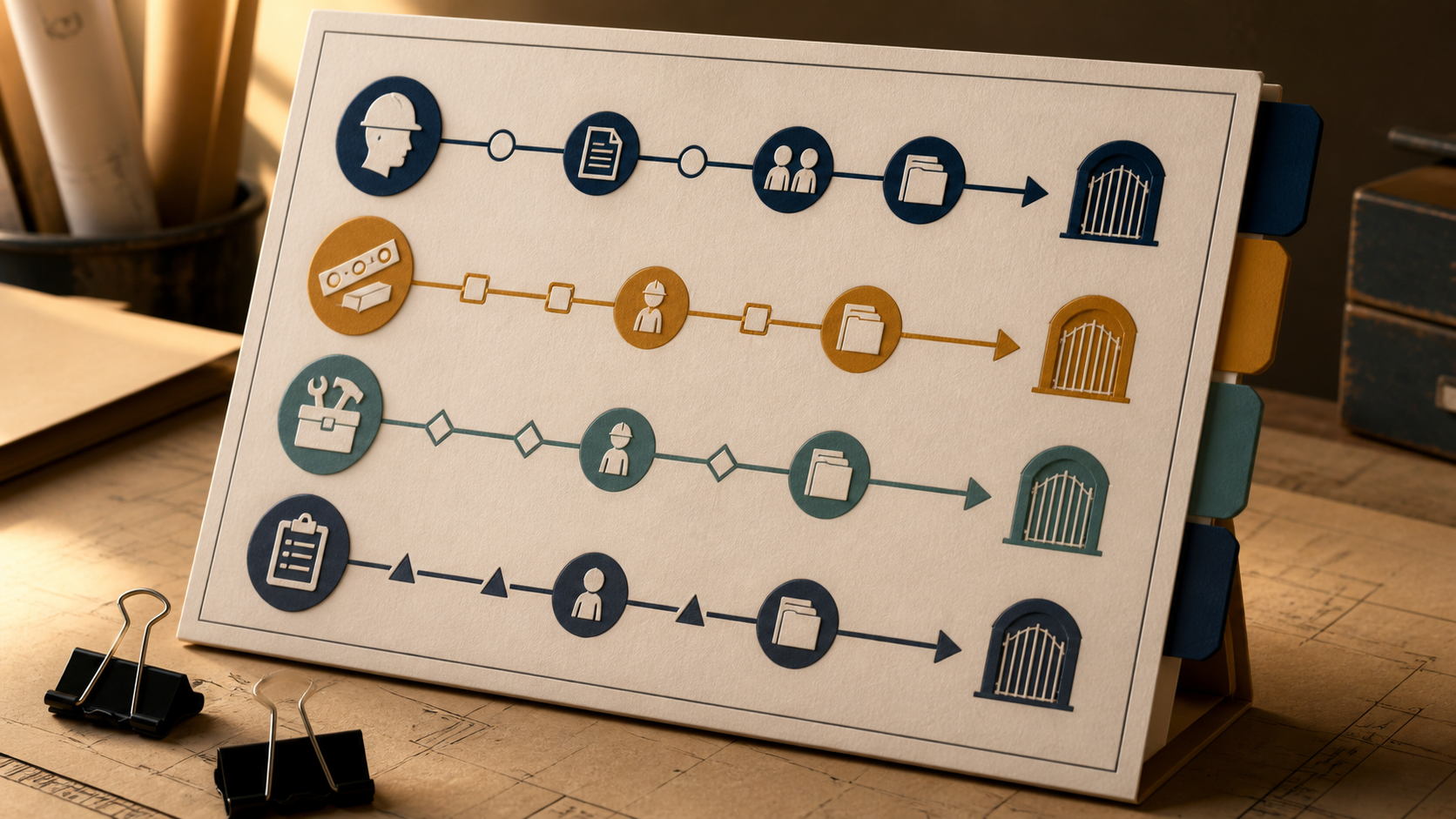
Before opening a form, ask one diagnostic question: who will qualify this license? California contractor license requirements begin with that person and the work classification they intend to support. The path then moves through experience, the correct application, board review, examinations and the conditions that apply before issuance.
This is not one pass-or-fail checklist. It is a sequence of gates. A person who has strong field experience may still need to clarify the qualifying role. A complete application packet can still face correction, fingerprint, examination or issuance steps. Finishing one gate does not erase the next one.
Use the map below to locate the first unresolved decision. If experience is uncertain, stop at evidence. If the relationship between the applicant and qualifying person is unclear, stop at the role. If both are settled, move to the current filing path rather than choosing a form from memory.
Find the first unresolved gate
Begin with the qualifying person and intended classification, then follow the first branch that still lacks evidence or a current instruction.
Experience evidence
Check classification, time, level, certifier and supportable records.
Qualifier role
Identify the person responsible for qualifying the applicant's construction operations.
Application path
Match the current form and supporting material to the applicant, qualifier and classification.
Completion gates
Keep review, fingerprints, examinations and issuance as separate decisions.
Use current CSLB instructions for the applicant's exact entity and license path. This map is an educational planning aid, not an approval decision or processing timeline.
Start with the eligibility fork: applicant or qualifier
Start by naming the qualifying person. That person must be at least 18 and have the experience and skills needed to manage the daily activities of a construction business, including field supervision. The qualifying person may be the individual applicant or may represent the applicant as its qualifying individual.
For an individual who plans to qualify personally, the first branch is straightforward: match that person's experience to the intended classification. For a business entity, identify the actual qualifying individual before treating the entity name as the answer. Every classification on the license needs a qualifying individual who meets the applicable experience and examination requirements and is responsible for the construction operations.
An uncertain role is a stopping point, not a detail to postpone. Do not assume that experience belonging to one person automatically qualifies another applicant or entity. Use the separate guide to identify the qualifying individual's role when ownership, employment or responsibility is not yet clear.
The short route is therefore: qualify, apply, complete. Those labels organize decisions; they do not promise a board timeline or suggest that each applicant follows identical procedures.
Three gates before license issuance
Qualify
Identify the qualifying person and test classification-specific experience and evidence.
Apply
Choose the current path and submit consistent application and experience materials.
Complete
Respond to review, examination and the issuance requirements that apply.
Use the sequence to locate dependencies. It is a planning map, not a guaranteed agency timeline.
Read the flow as a set of dependencies. A form cannot repair an experience gap, and an exam result cannot resolve an unidentified qualifier. Clear the earliest unresolved gate before investing effort in a later one.
Test experience against the intended classification
The qualifier generally needs at least four full years of experience in the requested classification within the 10 years immediately before filing. The accepted levels include journey level and work as a foreman, supervisor, contractor or qualifying owner-builder. The classification matters because broad construction familiarity is not a substitute for the experience tied to the requested scope.
Certification is a separate test from elapsed time. A qualified and responsible person with firsthand knowledge must certify the experience, and the record must be supportable with documentation if the board asks for it. A calendar claim without a suitable certifier or defensible project history is not ready simply because four years have passed.
Education is another branch, not a blanket replacement for experience. Documented education, technical training or apprenticeship may receive up to three years of credit, while at least one year must remain practical experience. Treat possible credit as something to document and verify, not as an automatic subtraction from the field requirement.
Use three outcomes for this gate:
- If time, level, classification and certification all appear aligned, move to the application path.
- If education or training may affect the calculation, gather the records before deciding that the experience test is complete.
- If the practical period, classification match or certifier is weak, stop and audit the qualifying experience evidence.
This branch keeps the hub narrow. The detailed evidence guide owns document quality and certifier preparation; the requirement here is to recognize whether that deeper audit is needed before filing.
Choose the filing path before assembling the packet
For the exam-required path, the applicant uses the current original-license application and Certification of Work Experience, submits the required supporting material, and pays the applicable application fee. Those are sequence facts, not permission to use a saved form without checking whether it matches the applicant's current entity and path.
Begin the packet only after the qualifying person and requested classification are settled. Otherwise, names, experience certification and application choices can drift apart. The useful pre-filing question is not “Do I have a form?” but “Does every document describe the same applicant, qualifier, classification and experience route?”
A ready branch has a current application path, consistent identity details, the experience certification and the required supporting material. A stop-and-verify branch has an uncertain entity type, qualifier relationship, classification or document instruction. Resolve that uncertainty at the source rather than guessing inside a field.
Keep a one-page packet index that names the applicant, qualifier, requested classification, experience certification and current application version. Use it to compare every attachment before filing. If one line cannot be completed confidently, return to that earlier gate instead of hiding the mismatch inside a cover note.
After submission, the acknowledgment includes an Application Fee Number and PIN used for status checks. Retain those details with the packet record. They help track the application; they are not an approval and do not predict when the next gate will finish.
When the route is known but the packet still needs organizing, assemble the CSLB application packet. That page owns the filing-level checklist, while this guide stays focused on choosing the right branch.
Keep acceptance, examination and issuance as separate gates
Submission starts review; it does not combine every later requirement into one event. The exam-required journey can include experience review, a correction or acceptance outcome, fingerprinting, exam preparation, issuance requirements and status tracking. The order matters because the applicant's next action depends on the current gate.
If the application needs correction, answer that issue before assuming the examination phase is active. Once an application is accepted as complete, affected applicants and listed personnel receive fingerprint instructions. Those fingerprints are checked against California Department of Justice and FBI records. Follow the current instructions sent for the application rather than treating a general summary as a personal notice.
Examinations are another gate, but passing does not itself issue the license. The application must be accepted and approved, and the applicant must satisfy the current issuance conditions that apply. Those may include the current fee, bond, asbestos, workers' compensation and entity-specific requirements.
Keep a simple status note with one line for each gate: application review, fingerprint or background step when applicable, examinations, and issuance documents. Record the actual notice or completed action beside the gate. Avoid filling blank lines with assumed dates, because queue information is not a guaranteed completion schedule.
The stopping rule is practical: respond to the gate the board has actually opened. Do not order later work around a hoped-for approval, and do not treat an exam result as proof that every issuance condition is complete.
Use the first unresolved gate to choose the next step
Choose the next planning task by the first unresolved gate, not by the task that looks easiest. Experience evidence, qualifying-individual responsibility and filing preparation are different problems. Solving the wrong one can produce a polished packet that still rests on an unclear foundation.
Run the readiness check immediately before making that choice. A checked item means you can identify the supporting person, record or current instruction. It does not mean the board has approved the application.
- The applicant entity is identified.
- The qualifying individual and intended classification are identified.
- The experience period, qualifying level, certifier and supporting evidence have been checked.
- The current application path and required supporting material are identified.
- Application acceptance, examinations and issuance remain separate later gates.
Apply this decision rule after the check:
- If the experience period, level, classification match or certifier is uncertain, use the experience evidence audit before filing.
- If the person responsible for qualifying the applicant is unclear, use the qualifying-individual role guide before assigning experience or forms.
- If the applicant, qualifier and classification are settled but the packet is not, use the application checklist to organize the filing materials.
- If those three gates are clear, move into examination planning while continuing to follow the current notices for acceptance, fingerprints and issuance.
This rule protects the semantic boundaries between the broad path and its support guides. It also leaves room for the applicant's route to change when a current official instruction or board notice identifies a different next action.
A workable license plan does not try to predict every outcome at the start. It names the qualifying person, verifies the experience route, selects the current application path and then responds to each later gate in order. Resolve the first weak link, preserve the supporting record and move forward from evidence rather than assumption.