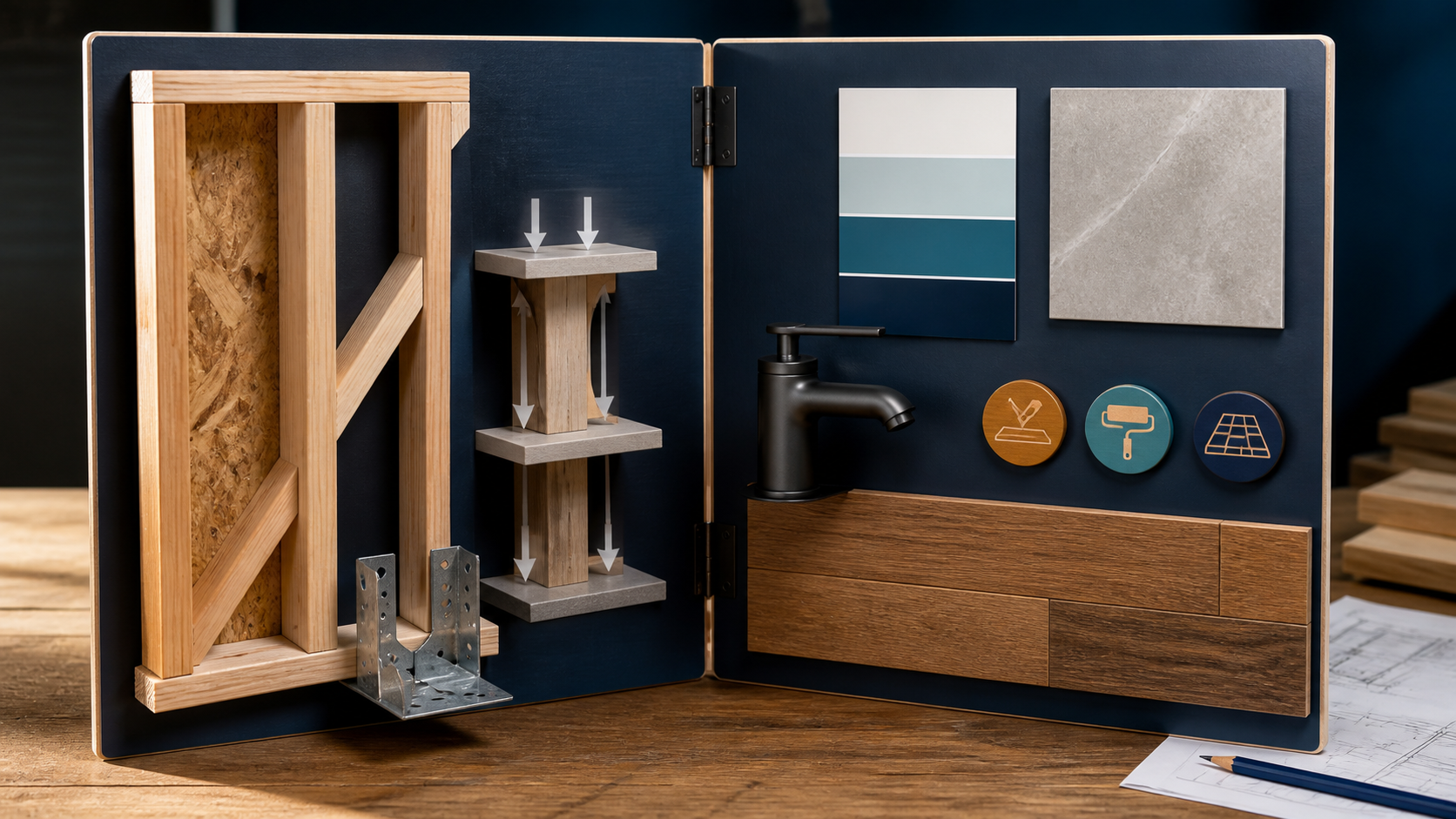
A remodel can look routine until one fact changes. Imagine work in an existing wood-frame home that includes flooring, painting and finish carpentry. Now add a load-bearing wall change and an extension of plumbing service. The label residential remodeling no longer answers the scope question by itself.
A California B vs B-2 contractor license comparison begins by separating those facts. B General Building and B-2 Residential Remodeling are distinct classifications. B-2 is not a smaller B, and a fact that excludes B-2 does not automatically prove that B covers the entire contract.
Use the five cases below as a reading method. Each version changes one part of the same remodel, records the new stop point and sends the complete fact pattern back to the current official descriptions. The examples are educational and do not decide the classification for a real project.
Open the casebook with structure, not the remodel label
The first case keeps the work inside a wood-frame residence that already exists and leaves the load-bearing portions unchanged. It includes several finish-related tasks under one contract. Those facts are relevant to B-2, but the words home improvement or remodel are not enough on their own.
The official B-2 description begins with improvements on or in an existing residential wood-frame structure when one contract requires at least three unrelated building trades or crafts. B has a different general-building scope centered on structures. For work beyond framing or carpentry, its official description uses its own combination-of-trades and specialty-work rules.
Before comparing labels, write four facts: the structure, whether it already exists, every task promised under the contract and the work that changes load-bearing portions or building systems. The table turns those facts into separate comparison lenses rather than a single yes-or-no shortcut.
Swipe horizontally to view all columns.
| Governing fact | B scope lens | B-2 scope lens | Stop and verify |
|---|---|---|---|
| Starting structure | Read the current general-building description for the structure and contracted responsibility. | Begins with improvements on or in a residential wood-frame building that already exists. | The structure type or existing condition is unclear. |
| Contract and trade combination | Apply the current B combination-of-trades and specialty-work rules. | One contract must require at least three unrelated building trades or crafts. | Tasks are listed, but their trade relationship is unresolved. |
| Load-bearing work | Do not assume coverage; compare the full structural responsibility with the current description. | Does not authorize structural changes to load-bearing portions. | Any load-bearing portion is proposed to change. |
| Electrical, mechanical or plumbing systems | Check the general-building and applicable specialty rules for the complete work. | Certain system work requires the appropriate classification or an appropriately licensed subcontractor; only limited fixture-related minor alterations are described. | A fixture task expands into system installation, replacement, substantial alteration or extension. |
Read across one row at a time. A row identifies what to verify; it does not authorize the work. If the structure or contract facts are still vague, the classification analysis is not ready to continue.
The broad California contractor classification scope map explains where B and B-2 sit among A and C. This page stays narrower: it follows the facts that separate these two building classifications.
Count the trades on one contract
The second case removes the structural change and keeps three listed tasks: finish carpentry, flooring and painting. For B-2, the governing question is whether one contract actually requires at least three unrelated building trades or crafts. Counting three line items is not the same as establishing three unrelated trades.
Test the relationship among the tasks. Several entries may describe phases of one trade, while a compact description may hide work from multiple crafts. Write the promised result beside each task, then compare the trade boundaries using the current classification descriptions. Do not split or rename a task merely to reach a number.
Now change the case: one contract includes many painting steps, from preparation through multiple coats and trim. The number of steps grows, but the reader still has to ask how many unrelated trades the contract requires. The exercise shows why a task count cannot replace a trade analysis.
Try a second variation: the estimate combines tile installation, drywall repair and paint. Record each promised result without deciding from the proposal headings. Then ask whether the crafts are unrelated under the applicable description and whether the agreement truly requires all of them. This keeps the exercise tied to contract scope instead of marketing categories.
For B, do not import the B-2 threshold. The general-building description has its own rules for work beyond framing or carpentry, including the required combination of unrelated trades and the option of holding or subcontracting the appropriate specialty classification. The correct next move is to read that description against the complete contract.
Once the official B description makes general building the study target, you can review the B General Building Contractor course. Treat it as supplemental study support only: it does not determine the classification for a specific contract.
If the decision is still between engineering, general building and specialty responsibility, step back to the A-versus-B-versus-C comparison. That broader family decision belongs outside this two-class casebook.
Stop when a load-bearing change appears
The third case returns the load-bearing wall change to the remodel. That single fact crosses an express B-2 restriction: B-2 does not authorize structural changes to load-bearing portions. The B-2 assumption must stop at that point.
Stopping B-2 is not the same as selecting B. The complete contract may contain specialty work, structural responsibility or other facts that still require review. Record the load-bearing change in plain terms, keep it with the rest of the promised work and compare the entire package with the current B description and any relevant specialty description.
The warning matters because the phrase smaller B encourages the wrong inference: if B-2 excludes something, B must include it. The official descriptions do not work as a simple ladder. They define different scope structures, and each must be read on its own terms.
A useful case note does not say B required. It says load-bearing portion changes; B-2 restriction reached; verify the B and specialty descriptions for the complete contract. That note preserves the fact without turning this article into a project ruling.
Separate fixture work from system work
The fourth case leaves the structure alone and changes the kitchen and bathroom details. One version includes finish work and specified fixture tasks. Another expands into electrical, mechanical or plumbing system installation, replacement, substantial alteration or extension. Those versions should not share one scope conclusion.
The B-2 description gives nonexclusive examples that include drywall, finish carpentry, flooring, insulation, painting, plastering, roof repair, siding, tiling and specified fixture work. Examples help readers identify facts to investigate, but they are not a blanket grant for every task near the named material or fixture.
Certain electrical, mechanical or plumbing system work requires the appropriate classification or an appropriately licensed subcontractor. The official boundary also preserves limited fixture-related minor alterations. The reader must distinguish the fixture itself, the minor alteration described, and the larger system work instead of collapsing them into one phrase such as update the kitchen.
Write the case in verbs. Replace fixture, extend supply, alter system and move service describe different proposed actions. Pair each verb with the affected system and the person expected to perform it. This inventory gives the official description something concrete to test.
Next identify the boundary between a minor fixture-related alteration and work on the underlying system. A fixture purchase, its connection, a relocated line and a service extension are not interchangeable facts. If the estimate leaves that boundary unclear, ask for a precise scope description before comparing classifications.
When a task changes during estimating, update the case note before relying on the earlier classification analysis. A finish-only description cannot carry forward unchanged after the contract expands into system work.
Flag restricted scopes before checking the official descriptions
The fifth case adds one specialized item. Fire-protection, asbestos-abatement or well-drilling work creates an explicit B-2 stop unless the contractor is appropriately classified or uses an appropriately licensed subcontractor. The official description identifies these as C-16, C-22 and C-57 boundaries.
Do not bury one of those facts in a general renovation summary. Name the work and the intended performer separately. The same discipline applies to any specialty work uncovered while reading the directory: a broad contract description should not hide the classification that controls a specific task.
Before opening the source pages, reduce the project narrative to a checkable fact list.
- Record the structure type, residential use, wood framing and whether the building already exists
- List every task required by the same contract and identify the related trade or craft
- Flag any proposed change to a load-bearing portion
- Separate specified fixture work and minor alterations from larger electrical, mechanical or plumbing system work
- Flag C-16 fire protection, C-22 asbestos abatement and C-57 well drilling work
- Open the current B, B-2 and any relevant specialty classification descriptions
- Write the fact that remains unresolved and seek an official or qualified project-specific determination
Use the completed checklist in a fixed order. First compare the structure and contract with the current B-2 description. Next apply every B-2 stop flag. Then compare the remaining full contract with the B description and any relevant specialty entries in the official directory. An unresolved fact stays unresolved; do not convert it into a favorable assumption.
The next-test rule is short: if changing one fact changes the scope question, record that fact and repeat the official-description check. If the issue is instead how an existing licensee files for another classification, move to the additional-classification process without importing its application or waiver questions into this comparison.
A reliable comparison ends with a better fact pattern, not a verdict from an example. Structure, contract, trades, load-bearing work, systems work and specialty restrictions should all be visible before the reader relies on a classification path.